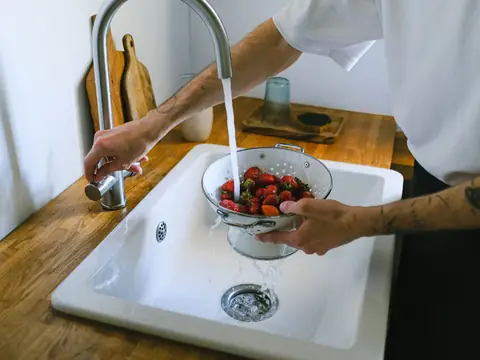
A whole house water filter treats the water where it enters your home, so every faucet, shower and appliance gets filtered water. It is the system to look at when you notice the same thing at every tap: a chlorine-like smell in the shower as well as the kitchen, a taste in the water from the bathroom sink, or sediment and stains around the house. This page explains what a whole house water filter in Tampa can and cannot do, how to choose one by certification, and what to ask before it is installed.
Water Filtration Tampa is an independent referral service, not an installer or plumber. When you send the form, your details are passed to an independent local water treatment pro, who can contact you and prepare a quote.
Want filtered water at every tap? Ask a local pro for a quote.
Point of entry versus point of use
Water treatment comes in two places. Point of entry means the system sits on the main water line and treats all the water coming into the house. Point of use means it treats the water at one fixture, like a reverse osmosis faucet at the kitchen sink. A whole-house filter is point of entry. If your concern is only what you drink, a point-of-use system may be all you need; if it is the water everywhere in the house, point of entry is the one to look at.

What Tampa city water starts as
If you are a City of Tampa Water Department customer, the city’s 2025 water quality report tells you what you are filtering. The main source is the Hillsborough River. The water is disinfected with chlorine and then ammonia, which forms chloramine. The average hardness was 211 mg/L, or 12.3 grains per gallon, and the average pH was 7.88. Customers of other providers nearby, or homes on a well, should start with their own report or a test.
What a whole-house filter can do
A filter does what its media is certified to do, and nothing more. That is why the first question is not which brand, but which contaminant. The usual advice holds anywhere: decide what you want to remove or reduce, then select a unit certified by NSF, Underwriters Laboratories or the Water Quality Association to remove that contaminant, and make sure the unit you are considering is certified for it.
| Standard | What it covers | Ask about it when |
|---|---|---|
| NSF/ANSI 42 | Aesthetic effects such as chlorine, taste and odor | You notice a chlorine-like taste or smell |
| NSF/ANSI 53 | Health effects such as lead | A test or your plumbing raises a concern |
| NSF/ANSI 401 | Incidental contaminants | You want a specific contaminant on the 401 list reduced |
| NSF/ANSI 44 | Residential water softeners | Your concern is hardness, not taste |
Chloramine is not the same as plain chlorine, and we found no primary source on which filter types reduce it, so this page makes no claim about it. If chloramine taste or odor is the reason you are looking, ask the installer whether the filter is certified for chloramine specifically, and check the listing yourself.
What a whole-house filter does not do
A filter is not a softener. It does not remove the calcium and magnesium that leave white spots and scale, so on Tampa city water, with an average of 12.3 grains per gallon, a filter alone will not stop spots on the glass. If you want both, ask about a filter and a water softener in Tampa together, and ask the installer how they will be arranged on the line for your water.
- Hardness, spots and scale: a softener, not a filter
- Drinking water treated for specific contaminants at one tap: reverse osmosis
- Bacteria in a private well: test first, then treatment chosen for the result
- Taste, odor and what its media is certified for, at every tap: a whole-house filter
Stains, color and taste: the EPA’s guidelines
Some of what people want filtered out is about appearance and taste rather than health. The EPA calls these nuisance chemicals and sets non-mandatory secondary standards for them, which it does not enforce. They are a useful checklist when you describe what you see.
| What you see or taste | Possible cause | EPA secondary guideline |
|---|---|---|
| Rusty color, reddish or orange stains, metallic taste | Iron | 0.3 mg/L |
| Black to brown color or staining, bitter metallic taste | Manganese | 0.05 mg/L |
| Salty taste | Chloride | 250 mg/L |
| Deposits, colored water, staining, salty taste | Total dissolved solids | 500 mg/L |
If you see stains or color, ask for a test for iron and manganese before choosing a filter. Treatment for those is chosen from the result, and the water treatment in Tampa page explains testing first.

What the installation involves
A whole-house filter is plumbed into the main line where the water enters the home. The installer chooses a spot with room to open the housings and change cartridges, fits valves so the filter can be isolated or bypassed during a change, and checks the water pressure before and after. If a softener is going in too, the two are planned together.
- Test the water, so the filter media is chosen for what is in it
- Pick the location on the main line, with access for cartridge changes
- Fit shut-off and bypass valves
- Install the housings and cartridges, then flush as the maker directs
- Check for leaks and check the water pressure
- Show you how to change the cartridges and use the bypass
Ask whether the work needs a permit. We could not confirm a City of Tampa rule, so check with City of Tampa Construction Services or ask the installer before work starts.
Upkeep: cartridges and media
Every filter’s media is used up over time. How often cartridges are changed depends on the model, the media and how much water your home uses, so follow the maker’s schedule for your unit rather than a general rule. Ask the installer which cartridges it takes, where to buy them and whether you can change them yourself.
Is a whole house water filter worth it?
It is worth it when the thing that bothers you is everywhere in the house and the filter you choose is certified for it. If the concern is only drinking water, an RO faucet or a filter at the sink may do the job. If the concern is hardness, a softener is the answer. A pro who tests first can tell you which of those you are dealing with, before you spend anything.
Questions to ask before you choose
- What did you test for, and what did you find?
- Which contaminants is this filter certified to reduce, and under which standard?
- Is it certified for chloramine specifically?
- What water pressure will I have after it is installed?
- Which cartridges does it take, and what does the maker’s schedule say?
- Do I need a softener as well for my water?
- Does the job need a permit, and who arranges it?
This site gives no prices: the quote depends on the system, the media, the size and your plumbing. Ask for it in writing, and compare what each quote is certified for, not only the total.
What to tell the pro
A few details make the first conversation more useful. Say where you notice the problem (one tap or every tap), what it is (taste, smell, color, stains or sediment), when it started, and whether anything changed around then, such as plumbing work or a new water heater. Add whether you are a City of Tampa Water Department customer, on another provider or on a well, and send a photo of where the main line enters the house if you can.
Getting a whole-house filter quote in Tampa
Send the form, choose whole-house filter, add your ZIP code and, if you like, a line on what you notice. Your request goes to the operator of this site, who passes it to an independent Tampa water treatment pro. That pro can contact you, talk through your water and prepare a quote. Asking is free and you never have to hire anyone.
Get a quote for a whole house water filter.
Questions people ask
Does a whole-house filter soften water?
No. A filter removes what it is certified for; hardness is a softener’s job. See water softeners in Tampa.
Will a whole-house filter remove chloramine?
Only if it is certified for it. Ask the installer which contaminants and which standard the filter is certified for, and check the listing.
How often are cartridges changed?
It depends on the model and your water use. Follow the maker’s schedule for your unit.
What is the best whole-house filter for Tampa?
There is no single best: choose one certified for what is in your water. A test comes first.
Does Water Filtration Tampa sell filters?
No. It is an independent referral service. Your request goes to an independent local pro, who can prepare a quote.
